Pronouns are an essential part of everyday language, used by everyone to refer to themselves and others. Understanding and respecting a person’s pronouns is a fundamental principle of inclusive and respectful communication.
Why are pronouns important?
Using someone’s correct pronouns shows that you respect them for who they are. When we all use correct pronouns, we create more inclusive and welcoming environments for everyone, whether in our workplaces, schools, social circles, families or online communities.
Using the wrong pronouns can feel dismissive and deeply hurtful. It can have detrimental impacts on a person’s mental health and overall sense of self.
Using pronouns
The best way to know someone’s pronouns is to ask them. Be sure to ask respectfully, preferably privately and share your own pronouns first. For example:
“I use [xx/xx] pronouns. Can I ask what pronouns you use?”
Avoid asking “What pronouns do you prefer?”, as a person’s pronouns and identity are not a preference.
Gendered Pronouns
She and He are gendered pronouns. She is typically used by female-identifying people. Similarly, He is typically used by male-identifying people. Both of these are sometimes used by people who don’t identify as male or female.
Gender Neutral Pronouns
They, them, theirs are common gender-neutral pronouns. These are basically pronouns that don’t imply ‘male’ or ‘female’. Gender neutral pronouns are typically used by gender diverse and non-binary identifying people.
Reference: Minus 18 – What are pronouns and why are they important?
What happens if I make a mistake?
Accidentally misgendering someone – using incorrect pronouns about or towards a person – can happen. Often, how we speak is a habit and changing that habit can take getting used to. But language is power.
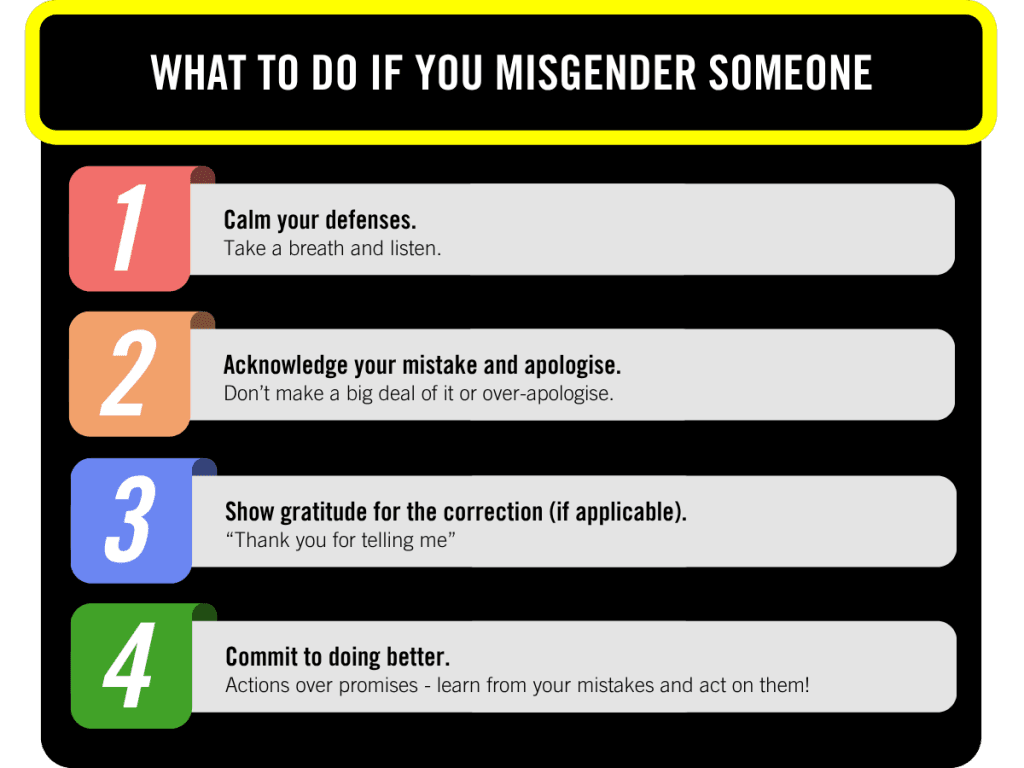
The best thing you can do if you make a mistake is to apologise and commit to doing better.
It’s important not to dwell on accidents too much by over-apologising or making a big deal of it (despite how guilty you may feel). Learning from your mistakes and acting on them is far more powerful!
What we can all do
Sharing your pronouns, even if your pronouns align with the sex you were assigned at birth, is important because it normalises the practice of sharing and helps create a more inclusive environment where no one feels pressured or singled out.
It also helps reduce assumptions around pronouns and encourages others to share, leading to fewer instances of misgendering.
Here’s when and where you can share your pronouns:
- When introducing yourself
- Email signatures
- Social media bios
- Name badges
- Zoom / Teams calls
Amnesty International is a global movement of more than 10 million people who take injustice personally. We are campaigning for a world where human rights are enjoyed by all – and we can only do it with your support.
Act now or learn more about our human rights work.