Marking one year since President Trump returned to office, Amnesty International today rang the alarm bells on increasing authoritarian practices in the United States and a devastating erosion of human rights.
In a new report released today, Ringing the Alarm Bells: Rising Authoritarian Practices and Erosion of Human Rights in the United States, Amnesty International documented how the Trump administration’s escalation of authoritarian practices, including closing civic space and undermining the rule of law, is eroding human rights in the U.S. and beyond.
“We are all witness to a dangerous trajectory under President Trump that has already led to a human rights emergency,” said Paul O’Brien, Executive Director of Amnesty International USA.
“By shredding norms and concentrating power, the administration is trying to make it impossible for anyone to hold them accountable. There is no doubt that these authoritarian practices by the Trump administration are eroding human rights and increasing the risk for journalists and people who speak out or dissent, including protestors, lawyers, students, and human rights defenders.”
“We are all witness to a dangerous trajectory under President Trump that has already led to a human rights emergency,”
Paul O’Brien, Executive Director of Amnesty International USA
The report includes twelve interconnected areas in which the Trump administration is cracking the pillars of a free society, including attacks on freedom of the press and access to information, freedom of expression and peaceful assembly, civil society organizations and universities, political opponents and critics, judges, lawyers, and the legal system, and due process.
The report also documents attacks on refugee and migrant rights, the scapegoating of communities and the rollback of non-discrimination protections, the use of the military for domestic purposes, the dismantling of corporate accountability and anti-corruption measures, the expansion of surveillance without meaningful oversight, and efforts to undermine international systems designed to protect human rights.
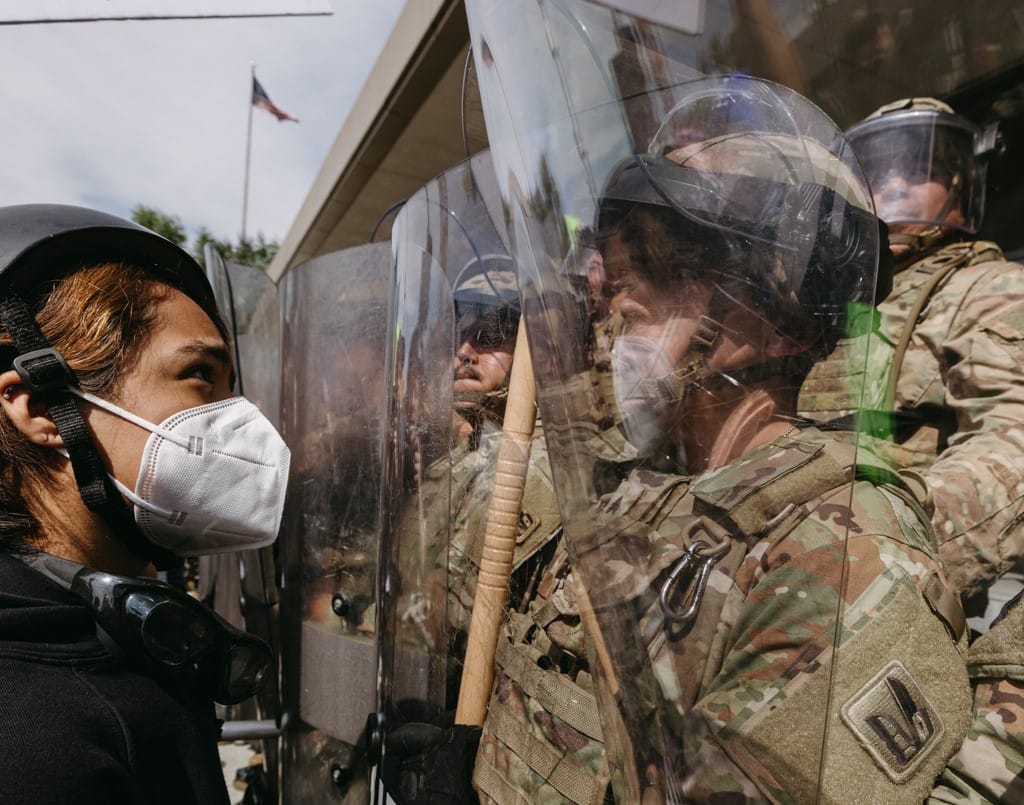
As detailed in the report, these authoritarian tactics are mutually reinforcing: Students are arrested and detained for protesting on college campuses, entire communities are being flooded and terrorized with masked ICE agents, and the militarization of cities across the U.S. is becoming normalized. At the same time, press intimidation makes human rights violations and abuses harder to expose; retaliation against protest makes people afraid to speak; expanding surveillance and militarization increases the costs of dissent; and attacks on courts, lawyers, and oversight bodies make accountability harder to enforce.
These tactics are clearly eroding human rights, including freedom of expression, peaceful assembly, freedom of the press, access to information, equality and non-discrimination, due process, academic freedom, freedom from arbitrary detention, the right to seek asylum, the right to a fair trial, and even the right to life.
Amnesty International has long documented similar patterns in countries around the world
While contexts differ, governments consolidate power, control information, discredit critics, punish dissent, narrow civic space, and weaken mechanisms meant to ensure accountability.
“The attack on civic space and the rule of law and the erosion of human rights in the United States mirrors the global pattern Amnesty has seen and warned about for decades,”
Paul O’Brien
“The attack on civic space and the rule of law and the erosion of human rights in the United States mirrors the global pattern Amnesty has seen and warned about for decades,” said O’Brien. “Importantly, our experience shows that by the time authoritarian practices are fully entrenched, the institutions meant to restrain abuses of power are already severely compromised.”
In the report, Amnesty International sets forth a comprehensive set of recommendations – to the United States Executive Branch, Congress, state and local governments and law enforcement agencies, international actors and other governments, corporate actors such as technology companies, and the public – aimed at reversing this embrace of authoritarian practices and preventing the normalization of increased repression and human rights violations. It calls for urgent action to protect civic space, restore rule of law safeguards, strengthen accountability, and ensure that human rights violations are neither ignored nor accepted as inevitable.
“We can, and we must, forge a different path. Authoritarian practices only take root when they are allowed to become normalized. We cannot let that happen in the United States.”
Paul O’Brien
“We can, and we must, forge a different path,” O’Brien said. “Authoritarian practices only take root when they are allowed to become normalized. We cannot let that happen in the United States. Together, we all have an opportunity, and a responsibility, to rise to this challenging time in our history and to protect human rights.”
Amnesty International is a global movement of more than 10 million people who take injustice personally. We are campaigning for a world where human rights are enjoyed by all – and we can only do it with your support.
Act now or learn more about our human rights work.