Following repeated rounds of fighting between the Syrian authorities and the Kurdish-led Syrian Democratic Forces (SDF), the military wing of the Kurdish-led Autonomous Administration of North and East Syria (AANES), in north-east Syria, and responding to the transfer of control to the Syrian authorities over some detention facilities and camps holding people suspected of affiliation to the Islamic State (IS), Amnesty International’s, Deputy Regional Director for the Middle East and North Africa, Kristine Beckerle, said:
“The Syrian authorities, in coordination with AANES, must carry out a human-rights-compliant screening process in detention facilities and camps they now control.”
Amnesty International’s, Deputy Regional Director for the Middle East and North Africa, Kristine Beckerle
“The Syrian authorities, in coordination with AANES, must carry out a human-rights-compliant screening process in detention facilities and camps they now control. They should identify those who should be investigated and prosecuted for crimes under international law or serious crimes under domestic law, those who should be repatriated, if appropriate, and prosecuted in their countries of origin, and those who should be released. National proceedings should meet international fair trial standards and be without recourse to the death penalty.”
“The Syrian authorities and the AANES must also urgently secure and preserve evidence of crimes under international law committed by IS, including sites of atrocities and mass graves and documentary evidence in detention facilities. Evidence of crimes left behind will be essential to establish the fate and whereabouts of the Syrians who have been disappeared by IS, as well as investigating and prosecuting the perpetrators of crimes under international law, including war crimes and crimes against humanity.”
“Repeated rounds of fighting in Syria have had devastating impacts on civilians.”
Kristine Beckerle
“Repeated rounds of fighting in Syria have had devastating impacts on civilians. Amnesty International reiterates its calls for all parties to the recent fighting to adhere to their obligations under international humanitarian law and ensure that civilians do not pay the price of another political breakdown in Syria.”
Background
After the fall of the former government of Bashar al-Assad in December 2024, the SDF continued to control large swathes of Syria’s north-east. In December 2025 and January 2026, hostilities broke out between the Syrian authorities and the SDF in Aleppo city, killing and injuring at least 20 civilians.
In mid-January, President Ahmed al-Sharaa issued Decree No. 13 of 2026 regarding the rights of Kurds in Syria and on 18 January announced a deal with SDF commander Mazloum Abdi covering civilian governance, border crossings, security integration, and state control of IS-related detention sites.
The deal collapsed on 19 January leading to a resumption of hostilities. Civilian objects, including infrastructure, were reportedly damaged and destroyed and, according to the UN, around 11,000 people were displaced to Qamishli in al-Hassake governorate due to fighting or out of fear of further escalation. On 20 January, a four-day ceasefire agreement was announced, although reports of some fighting continued.
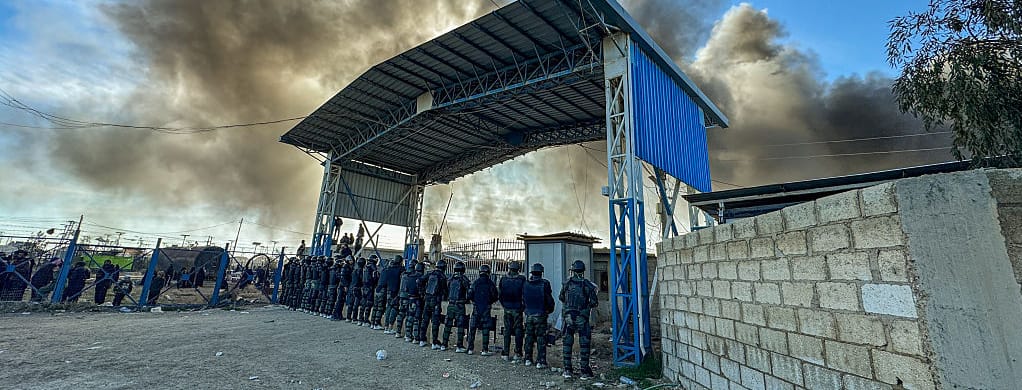
On 20 January, the Syrian authorities took control of some of the detention facilities where people are being held due to their perceived affiliation with IS, as well as al-Hol camp. The AANES continued to control other camps and detention facilities in north-east Syria.
In 2024, Amnesty International reported on the tens of thousands of men, women and children being held in detention camps and facilities in north-east Syria, including Syrians, Iraqis and other foreign nationals. Those detained include both perpetrators and victims of crimes committed by IS, including survivors of trafficking by IS, as well as people without any affiliation to the armed group. The victims also include possibly hundreds of Yezidi survivors as well as people from other minority communities who were abducted by IS. In 2025, Amnesty International called on the Syrian government, autonomous authorities, US-led coalition, and the UN to urgently identify long-overdue solutions to the crisis.
Amnesty International is a global movement of more than 10 million people who take injustice personally. We are campaigning for a world where human rights are enjoyed by all – and we can only do it with your support.
Act now or learn more about our human rights work.