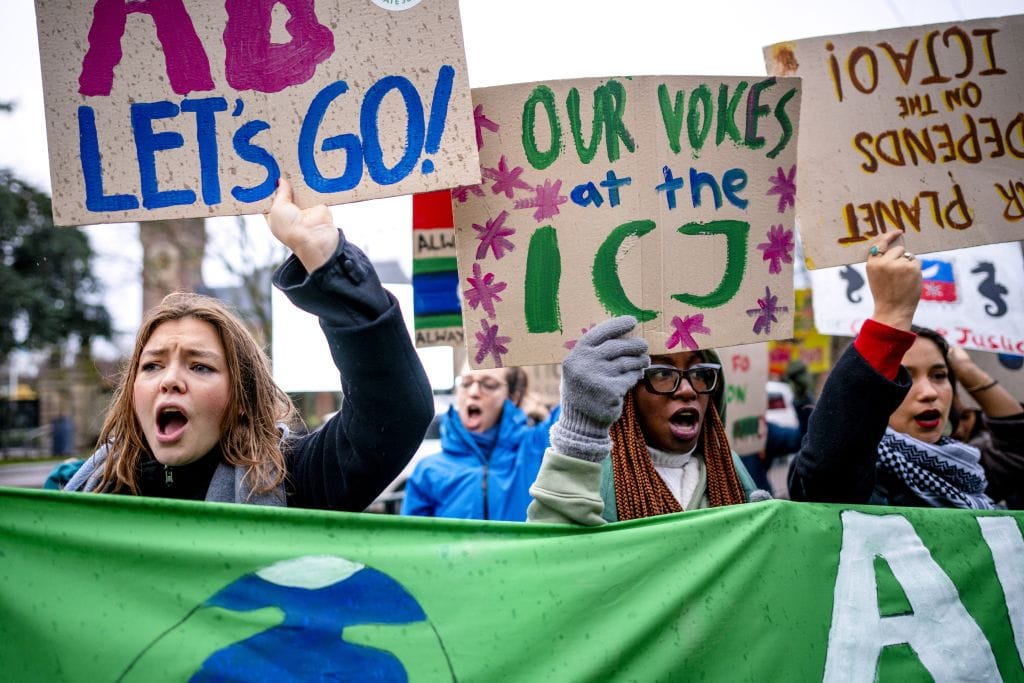
A draft United Nations (UN) resolution on climate change is seeking to turn the International Court of Justice’s (ICJ) Advisory Opinion on states’ obligations concerning the “urgent and existential threat” posed by climate change, into a roadmap for concrete action and accountability.
Although non-binding, the landmark opinion issued by the world’s highest court in 2025 is widely regarded as an authoritative opinion that clarified the obligations of states in respect of climate change.
It will significantly strengthen efforts to hold world leaders to account, guide the just and equitable phaseout of fossil fuels, reinforce climate laws and policies, and advance climate justice for billions of people globally.
UN member states are currently negotiating the draft resolution which gives full support to the ICJ opinion. They are expected to vote on the text towards the end of April 2026. Vanuatu, which has repeatedly warned that it could disappear under rising sea levels, is spearheading efforts to secure the resolution. The Pacific island nation and archipelago also led the diplomatic drive for the ICJ’s 2025 advisory opinion through active campaigning initiated by a group of young law students.
A core group of states contributed to the “zero draft” first version of the resolution, with cross-regional representation from Vanuatu, Barbados, Burkina Faso, Colombia, Jamaica, Kenya, the Marshall Islands, the Federated States of Micronesia, the Kingdom of the Netherlands, Palau, Philippines, Singapore, and Sierra Leone.
- What was the ICJ’s Advisory Opinion of 2025?
- What would the draft UN climate change resolution require governments to do, if adopted?
- Why does this resolution matter for human rights?
- Why has Vanuatu tabled this new UN climate change resolution now?
- Why are some countries opposed to the new UN climate change resolution?
- What happens next?
- What can you do right now?
What was the ICJ’s Advisory Opinion of 2025?
The historic Advisory Opinion marked the first time the ICJ had examined the international legal framework as it applies to climate change. It is a milestone that was made possible by years of campaigning that brought together governments, youth movements, civil society organizations and frontline communities demanding climate action.
In order to reach its opinion, 15 judges from around the world sought to answer two central questions: what obligations do states have under international law to protect the climate and environment from human-caused greenhouse gas emissions; and what are the legal consequences for governments where their acts, or lack of action, have significantly harmed the climate and environment?
In a rare unanimous opinion, the ICJ made it clear that protecting the global climate system is a legal obligation – not a political choice. Not to do so threatens human rights and the well-being of present and future generations. The ICJ also stated that countries must act together to remediate existing harm and prevent more climate havoc.
The key points of the ICJ’s Advisory Opinion:
- limiting global temperature rise to below 1.5°C above pre-industrial levels should be the primary temperature goal for all states, consistent with the Paris Agreement.
- where deemed relevant, international human rights law should be applied to determine states’ duty in addressing the climate crisis rather than being limited to specific climate agreements.
- the failure to phase out fossil fuels constitutes a wrongful act, including any continued exploration and provision of subsidies to the fossil fuel industry.
- states must cooperate to mitigate climate change and adapt to it to minimize harm, including through providing finance, technology and know-how.
- all countries have an obligation to address climate change; however, it is recognized that their responsibilities and capabilities will differ according to their circumstances.
- states are obliged to make full reparation for any loss and damaged caused by internationally wrongful acts.
- those forcibly displaced by climate change, including across borders, must be covered by non-refoulement protections; that is, protections against being returned to a country where they may face serious harm
What would the draft UN climate change resolution require governments to do, if adopted?
The zero draft resolution set out steps countries must take to limit dangerous heating, protect communities, and provide justice when harm occurs.
It calls on countries to:
- Keep to 1.5°C: Adopting and implementing national climate action plans aligned with keeping global heating below 1.5°C with efforts reflecting each State’s highest possible ambition;
- Pass Strong Climate Laws: Adopting and enforcing laws and policies to prevent global environmental harm and protect human rights from the adverse effects of climate change;
- Phase Out Fossil Fuels: Taking effective steps to protect the climate system from greenhouse gas emissions, including through measures to urgently and equitably phase out fossil fuel production, use and ending fossil fuel subsidies;
- Centre Frontline Communities: Ensuring the full, meaningful and equal participation of women, Indigenous Peoples, youth, and other marginalized groups in all forms of climate action;
- Protect Climate ‑Displaced People: Upholding the rights of people displaced by climate impacts and creating safe, regular and nondiscriminatory pathways for cross‑ border‑protection;
- Deliver Reparations: Providing full and prompt reparations when states violate their obligations, including through an International Register of Damage attributable to climate change and an accompanying International Mechanism for Climate Reparation.
These actions aim to stop climate harm at its source and support frontline communities most affected by climate change-related extreme weather, sea level rise, food insecurity and water stress.
Why does this resolution matter for human rights?
The ICJ recognized that “the environment is the foundation for human life, upon which the health and well-being of both present and future generations depend.” It confirmed that people cannot fully enjoy their human rights unless governments protect our climate system. Climate harms are already putting millions at risk.
By turning global legal standards into practical guidance for climate action, this resolution strengthens protections for people facing climate injustice and reinforces the reality that human rights and environmental protection are inseparable.
Why has Vanuatu tabled this new UN climate change resolution now?
Climate change is an unprecedented global human rights emergency. The burning of fossil fuels (coal, oil and gas) emits heat-trapping greenhouse gases that are the primary current and historical cause of climate change; this has been settled science for decades. The world is on track to exceed 1.5°C of warming within the next decade, making climate impacts more severe and pushing many ecosystems and communities to breaking point.
At the same time, political choices by some world leaders, like rolling back climate protections or revoking greenhouse gas rules, have weakened global progress just when we need stronger action. Fossil fuel infrastructure alone poses risks for the health and livelihoods of at least 2 billion people globally, roughly a quarter of the world’s population.
This resolution is a chance for governments to show they stand for climate justice rather than delay.
Why are some countries opposed to the new UN climate change resolution?
Higher income states, who have also been historically high-emitters, have benefited from decades of fossil fuel use and have contributed the most to greenhouse gas pollution. Today, these governments face growing expectations to lead on cutting emissions through just transitions to renewable energy accessible to all, and by providing technological support and grant-based climate finance for mitigation and adaptation to lower income countries which are the least responsible for climate change, yet most vulnerable to its harms. They should also provide reparations for climate change related loss and damage according to their level of responsibility.
Some powerful governments have pushed back because they fear accountability for historical responsibility and the financial obligations that follow. Yet we know that there is plenty of money to go around if polluters are made to pay for the damage they have caused.
What happens next?
UN member states are currently expected to vote on the resolution towards the end of April 2026. If governments adopt it, this will send a strong message that the world is ready to follow the ICJ’s legal guidance and turn it into concrete measures to protect people and the planet.
At a time when fragmentation between nations feels more visible than ever, the UNGA Resolution endorsing the ICJ Climate Ruling offers a renewed path for international cooperation. The resolution has the potential to shape global climate accountability for years to come and therefore UN Member States must engage constructively, support adoption, and protect the resolution’s ambition during negotiations.
What can you do right now?
You can support our call for governments to:
- back this resolution without weakening its commitments;
- stop delaying action to rapidly and equitably phase out fossil fuels production and use;
- protect people whose lives are already being devastated by the climate crisis;
- invest in a just and human rights centered transition to renewable energy that leaves no one behind.
Head to Amnesty Australia’s Instagram to learn more.
Amnesty International is a global movement of more than 10 million people who take injustice personally. We are campaigning for a world where human rights are enjoyed by all – and we can only do it with your support.
Act now or learn more about our human rights work.