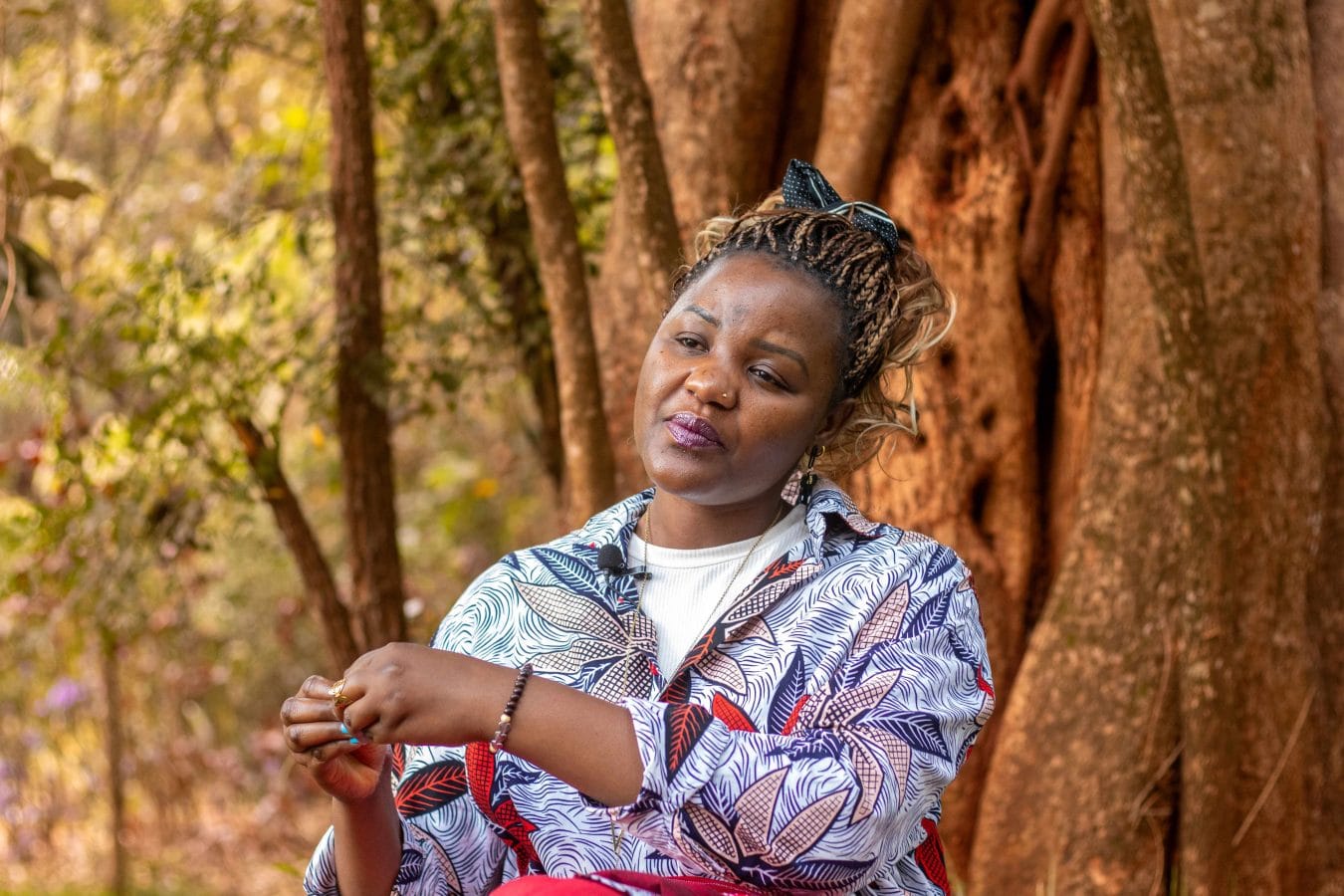
In 2018, Sylvie Njobati’s grandfather told her about a sacred ancient artefact known as Ngonnso, stolen by the Germans during the colonial period from 1884 to 1916, and donated to Berlin’s Ethnological Museum, by German Military Officer, Kurt Von Pavel.
Ngonnso was seen as a cultural cornerstone for the Nso people, an ethnic group from the Northwest Region of Cameroon, embodying their history and identity. Keen to see it returned to its rightful home during his lifetime, Sylvie’s grandfather asked her if she could try and bring it back to Cameroon.
Determined to make her grandfather proud, Sylvie launched the campaign #BringBackNgonnso and embarked on a lifechanging mission…
My grandfather was 75 when he bestowed a mission on me, involving a sacred wooden statue called Ngonnso.
Ngonnso was the founding mother of the Nso people. After her death, a wooden statue of her took on great significance and it was seen as a cultural cornerstone for the Nso people. During our conversations, my grandfather told me how it was taken by German colonial officer Kurt Von Pavel in 1902 and donated to Berlin’s Ethnological Museum.
My grandfather was a pastor, a wise man and my rock. His last wish was to return to the big compound [villages that make up the Nso Kingdom] he had abandoned, find Ngonnso and return it to its rightful place. But given his age, he needed my help. It was an opportunity to reconnect with my culture, and a history that had been intentionally denied as I didn’t have access to that kind of knowledge.
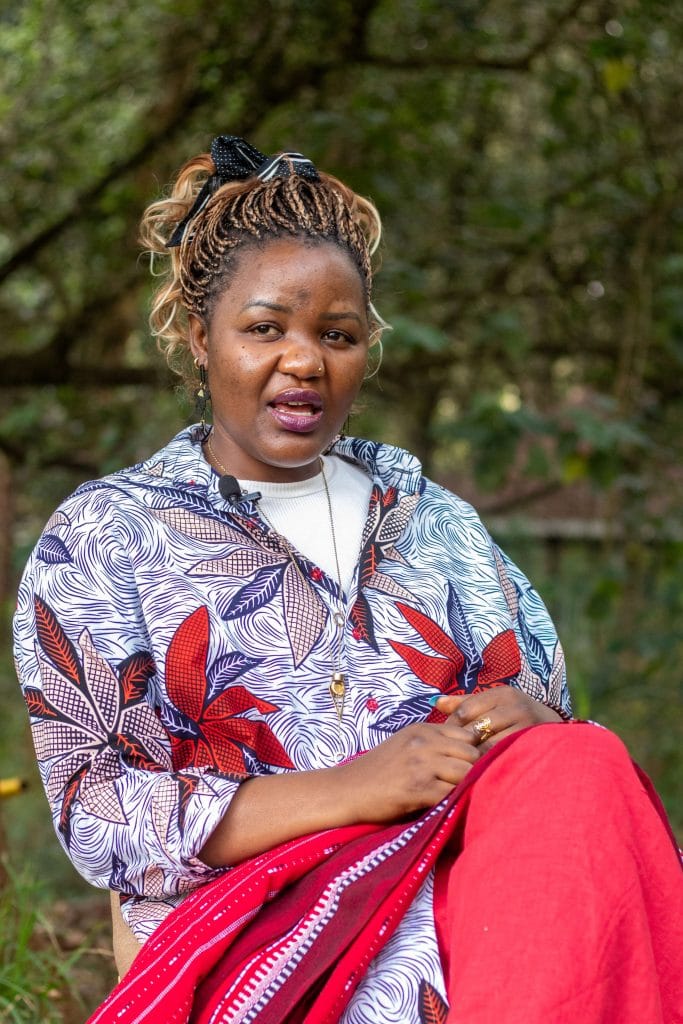
When I agreed to the mission, I didn’t know much about Ngonnso. We were never taught about it in school, however after researching the importance of it myself, I realised it was an opportunity to educate other people. If I could bring Ngonnso back, it would show how my people had survived the colonial era.
This mission wasn’t just for my grandfather; it was for my community too.
Starting the campaign
My community had been trying to return Ngonnso for close to 30 years. I started organizing talks in churches, local community groups and schools, where we talked about the restitution of Ngonnso. A key part of my campaign was film – and I knew if I wanted my campaign to reach my people and my community, I had to take them to Germany without them having to physically travel there. I filmed a piece with my grandfather, granting me this mission, and it captured the essence of the campaign. It was very powerful as it helped people understand the importance of objects, especially in the context of Cameroon.
Having started conversations with the community, the next step was to connect with the Germans and, most importantly, the institutions with the power to make decisions. To bring the campaign to life, I created a Facebook account – “the official restitution page for Ngonnso”. From there, a social media campaign was born, using the hashtag #BringBackNgonnso.
I researched institutions and individuals working on decolonization in German and contacted them, including the Prussian Cultural Heritage Foundation, the supposed owner of Ngonnso. In less than two weeks, I had a meeting with the German contact point for collections of colonial artefacts. During our conversation, I learnt an individual nor a community member could ask for restitution – it had to be done by the king, the local government, the president or the embassy.
The time to act is now
In 2021, Ngonnso was going to be on exhibition in Germany at the museum the, Humboldt Forum For us, this was sacrilege. I decided to go to Germany to make my voice heard. During my visit, I met the President of the Prussian Cultural Heritage Foundation, where I presented the official restitution letter. I played a clip of my grandfather saying how he would love to see Ngonnso returned. The room fell quiet. It was an incredible moment. My request of restitution was finally acknowledged and I was promised help going forward.
Sadly, during that week of meetings, my grandfather passed away. It was a difficult week, as I’d wanted to bring back Ngonnso before he passed. I felt so mad and questioned whether I’d been too slow. But in our culture, when someone passes on, they transcend. The passing of my grandfather reminded me that life is fragile. If you have to do something, then it now is the time.
I felt energized and motivated to keep going. After that, things moved quickly – we had a workshop in 2021, compiled the results in 2022 and by June of the same year, the decision to return Ngonnso to Cameroon had been confirmed.
I called our King to tell him, but I couldn’t stop thinking about my grandfather. When I returned to Cameroon, I wrote a letter to my grandfather and took it to his grave. I spoke to him and said I had brought good news. I knew he was smiling, wherever he was – he’s still smiling at me right now.
Restitution is a priority for my country
That was four years ago. Prior to my campaign, Cameroon was not interested in restitution. But now it’s a priority for them and they’ve created a commission in charge of illegally exported goods.
Ngonnso is still not back in Cameroon and it’s all to do with politics. The next step involves negotiations between Germany and the state of Cameroon. It’s frustrating as a lot of other people have passed without being able to see this happen.
I’ve learnt a lot from participating in this campaign and travelling to Germany. I have walked through museums, reliving the experiences of my ancestors. It inspires me to continue the fight, as I can reimagine what it was like then.
Reshaping the narrative
At the moment, it feels like we’re in the midst of a colonial resistance. We’re fighting for restitution and for reparations and we’re resisting so history doesn’t repeat itself. For me, restitution doesn’t just mean the physical return of objects. It also means reclaiming our stories and reshaping our narrative, so we can tell our own stories.
Reparations aren’t seen as a two-way street. Survivors and victims of these colonial crimes are having to fight for reparation, while the perpetrators – such as Germany in this case – fail to take any kind of initiative. We need to make space in our hearts to repair and heal, otherwise these conversations won’t amount anything.
To me reparatory justice also takes the form of access to information and awareness raising, at a community level. Having recently attended the Wakati Wetu Festival, alongside organizations such as Amnesty International, I hope we can help build and support campaigning at a grassroots level so conversations aren’t just taking place among a privileged few.
Sometimes, I feel as though I have exhausted all avenues as many of the people who were pushing for the return of Ngonnso have now passed away, but it just reminds me that I need to push harder. It can be exhausting at times, but I feel hopeful that Ngonnso will be returned in 2026.
This feature is part Amnesty International’s series on racial justice, reparations, and reclaiming narratives, ‘Voices of Restorative Justice’.
Amnesty International is a global movement of more than 10 million people who take injustice personally. We are campaigning for a world where human rights are enjoyed by all – and we can only do it with your support.
Act now or learn more about our human rights work.